
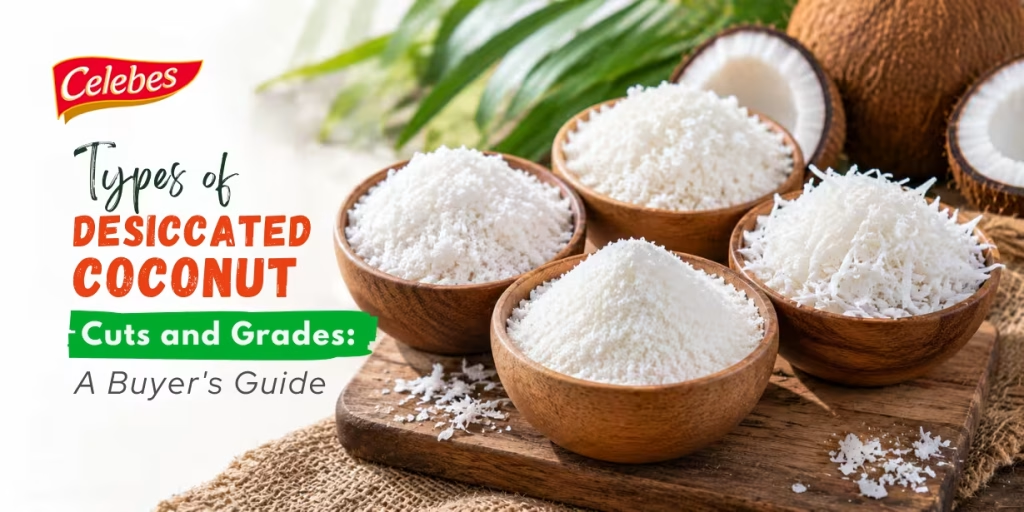
Pick up two bags of “desiccated coconut” from different suppliers and you might think you grabbed the wrong product by accident. One’s almost powder-fine, the other’s got visible strands you could pick out with your fingers. Both are correctly labeled. Desiccated coconut isn’t one thing, it’s a family of cuts and grades, and which one you end up with changes how it bakes, how it looks on a plate, and honestly, whether your recipe works at all.
If you’re a home baker branching into small-batch production, or a manufacturer placing your first bulk order, it pays to know the difference before you buy. (If you’re still deciding between desiccated coconut and another form altogether, we’ve also compared it directly against grated coconut and shredded coconut in separate guides.)
Fine, or Macaroon, Cut
Start at the small end. Macaroon cut (named for the obvious reason) is ground down into tiny, even particles that vanish into a batter rather than sitting there as lumps. That’s exactly why it shows up in macaroons and delicate pastry work, where you want the flavor of coconut without any texture fighting the rest of the bite. Confectionery lines running thousands of units a day like it for a less romantic reason too: small, consistent particles move predictably through mixing equipment, so batches come out the same every time.
Medium Cut
Medium is the workhorse. It’s coarser than macaroon but still fine enough for general baking, as a coating on truffles and candies, or scattered over a cake as a finishing touch. Walk through a market in parts of Southeast Asia and you’ll see medium-cut coconut dusted over rice cakes and traditional sweets constantly, it adds just enough texture without taking over the dish.
Fancy Shred and Flakes
Here the goal flips. Fancy shred and flaked cuts are longer, visibly distinct strands, and they’re not meant to disappear, they’re meant to be seen. Coconut-topped chocolates, layered desserts, specialty candy bars: these all lean on shred or flake specifically because the pieces hold their shape on top of the finished product instead of blending in.
Coarse Cut and Chips
At the far end you’ve got coarse cuts and actual coconut chips, which deliver a real crunch rather than a soft chew. This is where desiccated coconut starts overlapping with snack food, trail mix, granola, heartier baked goods. One thing worth checking with your supplier: whether their coarse cut is meant for baking or packaged specifically as a standalone snack, since the two aren’t always processed identically.
Toasted and Sweetened Finishes
Cut size is only half the story. Any of the above can also come toasted, which roasts in a deeper, nuttier flavor and a golden color, common in granola and dessert toppings. Or sweetened, for recipes that want that extra sugar built in. Toasted sweetened combines both for a more intense flavor you’ll often see in premium bakery and candy lines. In practice, most manufacturers can produce nearly any cut in natural, toasted, or sweetened form, so it usually comes down to what you specify on the order.
Matching the Cut to the Job
This isn’t just a cosmetic choice. Particle size changes how coconut absorbs moisture in a batter, how evenly it browns when toasted, and how repeatable your results are from batch to batch. If you’re experimenting at home, trial and error is fine, try a few, see what works. But if you’re formulating a product that needs to perform the same way every single run, guesswork gets expensive fast. Spec the exact cut and finish you need before you place the order, not after the first batch comes out wrong.
There’s also a practical supply-chain argument for sticking with one supplier across your whole coconut lineup. Juggling separate vendors and spec sheets for fine cut, medium cut, and chips adds friction you don’t need. One manufacturer covering the full range keeps quality and lead times consistent, which matters more than it sounds like until you’re the one chasing down three different suppliers before a production run.
Celebes Coconut Corporation produces desiccated coconut across the full range of cuts and finishes, backed by organic certification and export-grade quality control. Whether you need a fine macaroon cut for delicate pastry or a toasted coarse topping for something heartier, our team can help you land on the right spec the first time.
Not sure which cut your product actually needs? Get in touch with Celebes Coconut Corporation and we’ll help you figure it out, sample set included. You can also browse more sourcing guides like this one on our blog.